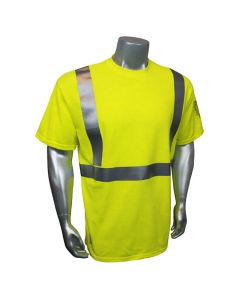
What Is a Class 2 FR T-Shirt?
A Class 2 FR T-shirt combines two separate certifications in one garment, a Class 2 high visibility rating and flame resistant protection. Most pair fluorescent fabric with reflective or retroreflective striping so you stay visible around vehicles and equipment, while the fabric itself is built to self extinguish rather than continue burning if it contacts flame or an electrical arc.
Class 2 and FR describe two different things, and you should never assume one guarantees the other. A Class 2 rating tells you about visibility. FR tells you the fabric resists flame. Neither one alone tells you whether a shirt is arc rated or how much thermal energy it can handle during an arc flash event.
If your job requires electrical or arc flash PPE, check the specific garment's arc rating, ATPV figure and the standards it is tested against before you rely on it. We list this information on every FR product page, so compare it against your employer's PPE program before you order.
Two Different Jobs in One Shirt
High visibility and flame resistance solve two separate problems, and a Class 2 FR T-shirt is built to solve both without asking you to layer extra gear over a plain shirt.
High Visibility Class 2 Protection
High visibility workwear helps drivers, equipment operators and coworkers spot you faster, which matters most on roadwork, construction sites, utility jobs and anywhere workers share space with moving vehicles or machinery.
Class 2 garments sit in the middle of the ANSI/ISEA 107 visibility scale, with more background material and reflective area than Class 1 and less than Class 3. Look for the ANSI/ISEA 107 label on any shirt your workplace requires to be ANSI compliant, and check our Class 2 T-Shirts collection if you need high visibility without flame resistant fabric.
Flame Resistant Protection
Flame resistant clothing is designed to self extinguish and limit burn injury when it is selected correctly for the hazard and worn as intended. FR fabric will not guarantee zero injury. It is built to buy you time and reduce the severity of a burn.
FR workwear shows up across oil and gas, utilities, electrical work and industrial plants, and the right shirt for you depends on your specific hazard assessment. Browse our full FR Shirts collection or the broader FR Clothing lineup to compare fabric types and ratings side by side.
Who Actually Needs a Class 2 FR T-Shirt
Electricians and electrical workers, utility crews, construction workers and industrial professionals make up most of the people who reach for this category. Here is what matters for each.
Electricians and Electrical Workers
If your electrical safety program requires flame resistant or arc rated clothing, do not stop at the words FR or Class 2 on the tag. Confirm the shirt's arc rating and whether it meets ASTM F1506 and the guidance referenced in NFPA 70E. Terms worth knowing before you shop include arc flash, arc rated clothing, ATPV, arc rating in cal/cm², and PPE category.
Utility Workers
You spend your shift around roads, vehicles, power lines and changing weather, so a shirt that covers both visibility and flame resistance in one layer saves you a step every morning. Power utility workers, line workers, utility contractors and public works crews are among the professionals we hear from most often about this category.
Construction Workers
Between moving equipment, vehicles, tools and electrical systems, a construction site rarely has just one hazard. A Class 2 FR T-shirt gives you visibility and flame resistant properties in the same shirt for road construction, highway work, utility construction and general field service.
Industrial Workers
Maintenance technicians, refinery workers, oil and gas crews, and other industrial professionals often need a shirt that holds up through a full shift of movement while still meeting the visibility and FR requirements written into their PPE program. Review the fabric composition, care instructions and any arc or thermal rating listed on the product page before you add a shirt to your kit.
What to Look for in a Class 2 FR T-Shirt
The right shirt depends on your hazards, not just the category name on the label. Here is what to compare before you buy.
Flame Resistant Fabric
FR shirts are made from different materials and constructions, including FR cotton, modacrylic, FR blends, jersey knit, inherently FR fabrics, and treated FR fabrics. Each product page lists the exact fabric composition and flame resistant properties, so check it before you compare price alone.
High Visibility Design
Depending on the shirt, look for an ANSI/ISEA 107 classification, Class 2 visibility, fluorescent fabric, reflective tape, retroreflective material, reflective striping, and the high visibility color your job requires.
Comfort for a Full Shift
FR fabric that fights you all day defeats its own purpose if you stop wearing it correctly. Look for breathable fabric, moisture wicking properties, lightweight construction, and a crew neck or sleeve style that matches how you actually move on the job.
The Standards Behind Your FR Shirt
A handful of standards show up again and again on FR and high visibility labels. Knowing what each one actually covers helps you read a spec sheet instead of guessing.
ANSI/ISEA 107 Class 2
ANSI/ISEA 107 is the standard most often referenced for high visibility safety apparel in the United States. Class 2 is a visibility classification within that standard, not an FR rating. A shirt can meet ANSI/ISEA 107 Class 2 while its flame resistant and electrical protection properties are determined completely separately. You can review the standard directly through ANSI.
ASTM F1506
ASTM F1506 covers performance specifications for flame resistant and arc rated textile materials used in electrical work. If your job requires ASTM F1506 compliance, verify that the specific shirt you are buying is listed as meeting it, not just FR in general terms. ASTM International publishes the full standard.
NFPA 70E and PPE Categories
NFPA 70E addresses electrical safety in the workplace, including how PPE is selected based on the arc flash hazard at a given task. Under NFPA 70E, PPE is grouped into categories, often referred to as PPE Category 1 through 4, with each category tied to a minimum arc rating in cal/cm². Your employer's arc flash hazard assessment determines which category applies to your task, and that determines the minimum arc rating your FR shirt needs to carry. Full details live on the NFPA site.
ATPV and cal/cm²
ATPV, or Arc Thermal Performance Value, measures how much thermal energy a fabric can withstand before it is likely to cause a second degree burn. Ratings are expressed in cal/cm², and a higher number means more protection against a given arc flash exposure. Use the shirt's stated rating, never an assumption, when you are matching PPE to a hazard category.
Is Class 2 the Same as Arc Rated
No. Class 2 describes a high visibility classification. Arc rated describes protection against the thermal effects of an electrical arc. An FR shirt may or may not carry an arc rating depending on how it was designed and tested, so always check the individual product specification rather than assuming the two go together.
Your FR Shirt Is Part of a Layered System
A Class 2 FR T-shirt protects the parts of your body it covers, and that is only part of the picture. NFPA 70E calls for coverage of all skin that could be exposed during an arc flash event, which usually means pairing your FR shirt with FR rated pants and, depending on your task, an FR jacket or vest over the top. Every layer in the system needs to be non melting and rated for the hazard, since one uncovered gap can undercut the protection the rest of your outfit provides. If you are building a full FR kit, check our Safety Clothing collection for matching pants, jackets and outerwear rated for the same hazard category as your shirt.
Class 2 FR T-Shirts vs Standard Hi Vis T-Shirts
Both a Class 2 FR T-shirt and a standard hi vis T-shirt can make you easier to see, but they are not built for the same hazards.
|
Feature
|
Class 2 FR T-Shirt
|
Standard Hi Vis T-Shirt
|
|
High visibility
|
Yes, where specified
|
Depends on garment
|
|
Class 2 classification
|
Where specified
|
Depends on garment
|
|
Flame resistance
|
Yes, where specified
|
Not necessarily
|
|
Reflective material
|
Product dependent
|
Product dependent
|
|
Arc rating
|
Product dependent
|
Not necessarily
|
|
Electrical applications
|
Product dependent
|
Not necessarily
|
|
PPE suitability
|
Depends on workplace requirements
|
Depends on workplace requirements
|
If flame, flash fire, or electrical hazards are part of your job, do not choose a shirt on visibility alone. Compare the full spec sheet against your PPE program before you order. Our Class 2 T-Shirts page covers standard high visibility options if FR protection is not required for your role.
How to Choose the Right Class 2 FR T-Shirt
Start With Your Jobsite Hazards
Identify what you are actually exposed to first, whether that is traffic, heavy equipment, flame, flash fire or arc flash risk. Choose your shirt based on those hazards, not on whichever category sounds the most protective.
Check the Required Standards
Review the standards listed on the product, which may include ANSI/ISEA 107, ASTM F1506, NFPA 70E or NFPA 2112 depending on the application. Not every Class 2 FR shirt meets every standard, so read the individual listing rather than the category name.
Confirm the Arc Rating When You Need One
If your task involves electrical work, find out whether your employer's hazard assessment requires an arc rated garment, then check that shirt's ATPV or cal/cm² rating against the required PPE category.
Pick the Right Fit and Construction
Think about how you actually wear your PPE day to day. We carry men's FR T-shirts in short sleeve and long sleeve, lightweight and breathable builds, and moisture wicking fabrics, so match the construction to your climate and job requirements.
Shop Class 2 FR T-Shirts at Hi Vis Kings
We carry Class 2 FR T-shirts built for the hazards electricians, utility crews, construction teams and industrial workers actually face. The Radians LHV-FR-TS is a solid example of what to look for. It meets ASTM F1506 with a 10 cal/cm² arc rating, meets NFPA 70E, and carries an ANSI Class 2 Type R rating with FR reflective striping on the front and back.
Browse our full FR Shirts collection to compare fabric, fit and arc rating side by side, or check the broader FR Clothing lineup for matching pants, vests and jackets. If FR protection is not required for your role, our Class 2 T-Shirts collection covers standard high visibility styles, including options like the GSS 5125 for women. Whatever the job calls for, review the specifications on each product page so you know exactly what protection you are getting before it ships.
FAQs
1. What is a Class 2 FR T-shirt?
A Class 2 FR T-shirt is a high visibility work shirt with flame resistant properties. Class 2 refers to the shirt's high visibility classification, while FR refers to flame resistance. Standards, certifications and protection levels vary by product, so check the individual listing.
2. What does Class 2 mean on a safety shirt?
Class 2 refers to a high visibility classification under ANSI/ISEA 107, used for garments intended to improve visibility in work environments like roadwork or construction. Class 2 by itself does not indicate flame resistance or arc flash protection.
3. What does FR mean on a T-shirt?
FR means flame resistant. FR fabric is designed to resist ignition and limit the effects of flame exposure under the conditions it was tested for. Protection level depends on the garment's design, testing and applicable standards.
4. Are Class 2 FR T-shirts arc rated?
Not automatically. A shirt can be Class 2 and flame resistant without carrying an arc rating. If you need arc flash protection, check the product's arc rating, ATPV or cal/cm² figure and the standards it meets before you rely on it.
5. What is the difference between Class 2 and Class 3 safety shirts?
Class 2 and Class 3 are both high visibility classifications, with Class 3 requiring more background and reflective material for higher risk, higher speed or lower light environments. The right class depends on your work environment and applicable safety requirements.
6. What is ASTM F1506?
ASTM F1506 covers flame resistant and arc rated textile materials used for electrical work. If your job requires ASTM F1506 compliance, confirm the specific garment is listed as meeting it.
7. What is NFPA 70E?
NFPA 70E addresses electrical safety in the workplace, including how PPE is selected based on arc flash hazard category. It is one of the standards you will see referenced on arc rated FR clothing.
8. What does ATPV mean on FR clothing?
ATPV stands for Arc Thermal Performance Value, a measurement used to describe the thermal protection an arc rated fabric provides during an arc flash exposure, expressed in cal/cm².
9. Who should wear Class 2 FR shirts?
Electricians, utility workers, construction crews, industrial workers, road crews and maintenance technicians are among the professionals who typically need both visibility and flame resistant properties based on their workplace hazards.
10. How should FR T-shirts be washed?
Follow the care instructions on the garment label. Do not assume standard washing, bleach or fabric softener is safe for every FR garment, since the wrong care routine can affect the fabric's flame resistant properties over time. Reference OSHA and your employer's PPE program for any additional care or inspection requirements tied to your role.
Gear Up Before Your Next Shift
Your shirt should not be the weak link between you and the hazards you deal with every shift. Once you know your jobsite risks and the standards your PPE program requires, matching the right Class 2 FR T-shirt becomes a quick decision instead of a guessing game.
Shop our full Class 2 FR T-Shirts and FR Shirts collection, or reach out to our team if you want help matching a shirt's arc rating to your hazard category before you order.