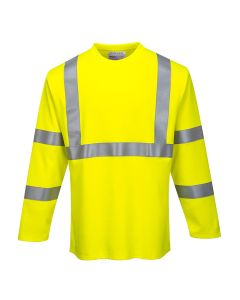
What Makes a Shirt "Class 3 FR"?
A Class 3 FR long-sleeve shirt must satisfy two independent certifications simultaneously: high-visibility compliance under ANSI/ISEA 107 and flame resistance under NFPA or ASTM standards. Understanding both helps you choose the right garment for your work environment.
Class 3 Hi-Vis (ANSI/ISEA 107 Type R)- Requires a minimum of 1,240 square inches of background high-visibility material and at least 201 square inches of retroreflective striping. Long sleeves are required to meet Class 3 coverage- short-sleeve shirts can only achieve Class 2 status. Retroreflective bands must appear on the sleeves to ensure 360° visibility at night and in low-light conditions.
Flame Resistant (FR) - The fabric must self-extinguish when exposed to a flame and not continue to burn if the heat source is removed. This protection is tested under NFPA 2112 (flash fire), NFPA 70E / ASTM F1506 (arc flash), and ASTM F1959 (arc rating).
The arc rating (ATPV) is measured in calories per square centimeter (cal/cm²) and indicates how much incident energy the garment can withstand before causing a 50% probability of second-degree burns.
Why both certifications matter on one garment- Workers in electrical utilities, highway construction, oil and gas, and pipeline maintenance routinely face both traffic exposure and thermal hazards in the same shift.
A single dual-certified Class 3 FR long-sleeve shirt meets OSHA 1910.269, ANSI/ISEA 107, and NFPA 70E requirements without the need to layer or swap garments.
Who Needs a Class 3 FR Long Sleeve Shirt?
A Class 3 FR long sleeve shirt is required- not optional- for workers in environments that combine high-speed traffic exposure with electrical or thermal arc hazards. OSHA and NFPA standards specify when and where each level of protection applies.
Workers typically required to wear Class 3 FR long sleeve shirts include:
- 1. Electrical utility linemen and substation workers- NFPA 70E and OSHA 1910.269 require FR clothing rated for the arc flash incident energy of the work environment- Class 3 hi-vis adds required traffic visibility for roadside utility work.
- 2. Highway and road construction crews- OSHA 23 CFR Part 634 and the MUTCD require Class 3 garments when workers are exposed to traffic at speeds exceeding 50 mph or in complex work zones at night.
- 3. Oil and gas pipeline workers: Flash-fire hazards from flammable vapors require NFPA 2112-compliant FR clothing; roadside pipeline work also triggers hi-vis requirements.
- 4. Power line and telecommunications crews- Aerial and ground crews near energized lines require both arc flash protection and high visibility per OSHA 1926.
Compliance note- OSHA 1910.269 requires employers to assess arc flash incident energy levels and provide FR clothing rated at or above that level. Class 3 visibility must be maintained when work is performed near traffic. A single Class 3 FR long-sleeve shirt that satisfies both ANSI/ISEA 107 Type R and NFPA 70E fulfills both requirements.
Key Features to Look for in a Class 3 FR Long Sleeve Shirt
Not all Class 3 FR shirts are built the same. These are the features that separate a garment that meets the minimum standard from one that performs across a full workday in demanding conditions.
|
Feature
|
What to Look For
|
Why It Matters
|
|
ATPV Rating
|
Minimum 8 cal/cm² (CAT 2)
|
Determines the protection level against arc flash energy
|
|
Fabric Type
|
Modacrylic blend, Nomex®, or FR cotton
|
Affects comfort, durability, and inherent vs. treated FR
|
|
Reflective Tape
|
2" silver segmented 3M Scotchlite®
|
Industry-standard retroreflective material for day/night visibility
|
|
Hi-Vis Color
|
Lime yellow or safety orange
|
ANSI 107-compliant colors only- other colors do not qualify
|
|
Sleeve Coverage
|
Full-length sleeves with reflective bands
|
Required to achieve Class 3 Type R visibility rating
|
|
Moisture Management
|
Moisture-wicking or FR-safe moisture finish
|
Critical for hot or humid environments without compromising FR integrity
|
|
Certification Labels
|
UL classification mark (NFPA 2112) + ANSI 107 Type R Class 3 hang tag
|
Confirms third-party testing- do not rely on self-certification alone
|
|
Fabric Weight
|
5.7 oz–8 oz for long sleeves
|
Lighter = more breathable- heavier = more durable for abrasive environments
|
Inherent FR vs. Treated FR- Which Is Better?
Inherent FR fabrics (such as modacrylic blends, Nomex®, or Aramid fibers) have flame resistance built into the fiber itself. The protection does not wash out or degrade with laundering and lasts the life of the garment.
Treated FR fabrics (such as FR-treated 100% cotton) receive a chemical flame-retardant finish during manufacturing. These garments are often more affordable and comfortable, but protection can diminish over time if improperly laundered. Following the manufacturer's care instructions exactly is critical for maintaining compliance.
For environments with frequent washing or long garment lifecycles, inherent FR fabrics offer more consistent protection over time.
ANSI Class 3 vs. Class 2 FR Shirts- Which Do You Need?
Class 2 FR shirts meet a lower visibility threshold and are suitable for environments with moderate traffic exposure or lower-speed work zones. Class 3 FR long-sleeve shirts provide the maximum level of visibility under ANSI/ISEA 107 and are required when workers face higher-speed traffic, complex work environments, or nighttime conditions.
|
Requirement
|
Class 2 FR Shirt
|
Class 3 FR Long Sleeve Shirt
|
|
Background material
|
Min. 775 sq. in.
|
Min. 1,240 sq. in.
|
|
Reflective material
|
Min. 201 sq. in.
|
Min. 201 sq. in.
|
|
Sleeve coverage
|
Not required
|
Required (enables Class 3 rating)
|
|
Traffic speed
|
Up to ~25–50 mph work zones
|
50+ mph or complex environments
|
|
Nighttime work
|
Limited
|
Yes- full retroreflective coverage
|
|
Arc flash rated
|
Optional
|
Required for electrical hazard work
|
Rule of thumb- If your job site is near roadways with posted speeds above 50 mph, if you work at night, or if your work environment is described as "complex" under the MUTCD, Class 3 is required. If you also work near energized equipment or in arc flash hazard zones, the shirt must additionally carry FR certification.
Understanding Arc Flash Ratings on FR Shirts
The arc rating on a Class 3 FR shirt is expressed as an ATPV (Arc Thermal Performance Value) in cal/cm². This number indicates the maximum arc flash energy the garment can withstand before a 50% probability of a second-degree burn injury.
NFPA 70E organizes arc flash hazards into Hazard Risk Categories (HRC), now called PPE Categories:
|
PPE Category
|
Minimum Arc Rating
|
Typical Work Tasks
|
|
CAT 1
|
4 cal/cm²
|
Electrical panel work, 240V systems
|
|
CAT 2
|
8 cal/cm²
|
Switchgear work, motor control centers, 600V systems
|
|
CAT 3
|
25 cal/cm²
|
Medium-voltage switching, 15kV systems
|
|
CAT 4
|
40 cal/cm²
|
High-voltage switching above 15kV
|
Most Class 3 FR long-sleeve shirts on the market are rated CAT 2 (8–10 cal/cm²), which covers most electrical utility and construction work. Workers in higher-voltage environments should verify the specific ATPV of each garment against their site's arc flash hazard analysis.
How to Care for FR Long Sleeve Shirts
Proper laundering is essential to maintain both the flame-resistant properties and the hi-vis colorfastness of Class 3 FR shirts. Incorrect care can degrade the FR finish on treated garments and fade the fluorescent background material, reducing both safety and compliance.
Do:
- Wash in warm water (not hot) with a mild, phosphate-free liquid detergent.
- Tumble dry or hang dry to preserve fluorescent color.
- Inspect each garment before use for holes, tears, faded reflective tape, or color degradation.
- Follow the manufacturer's care label- it is the authoritative source for that specific fabric.
Do not:
- Use chlorine bleach- it destroys FR properties in treated garments and fades hi-vis colors.
- Use fabric softeners- they coat fibers and can suppress FR performance.
- Use starch- it increases flammability and is not compatible with FR fabrics.
- Wash FR garments with heavily soiled laundry containing flammable contaminants (grease, oils)
Important- For inherent FR fabrics (modacrylic, Nomex®, Aramid blends), FR protection is built into the fiber and is not affected by laundering. For treated FR cotton, proper care is critical to maintain the chemical finish. When in doubt, check the garment's care label for specific instructions.
When to replace a Class 3 FR shirt:
- 1. Fluorescent background material has faded to a dull or pale color.
- 2. Reflective tape is peeling, torn, or no longer retroreflective.
- 3. Fabric has holes, tears, or thinning that exposes skin to hazards.
- 4. The garment no longer meets the visible criteria under ANSI/ISEA 107
Frequently Asked Questions
1. What is a Class 3 FR long sleeve shirt?
A Class 3 FR long sleeve shirt is a garment certified to two standards simultaneously- ANSI/ISEA 107 Type R Class 3 for high visibility (requiring at least 1,240 sq. in. of fluorescent background material and 201 sq. in. of retroreflective striping, including on the sleeves) and a flame-resistant standard such as NFPA 2112 or NFPA 70E, which requires the fabric to self-extinguish when exposed to a flame source and has an arc rating of minimum 8 cal/cm² for CAT 2 protection.
2. Are Class 3 FR shirts OSHA compliant?
Yes- Class 3 FR long sleeve shirts that are certified to ANSI/ISEA 107 Type R Class 3 and NFPA 70E (ASTM F1506) or NFPA 2112 meet OSHA requirements for workers in electrical hazard environments near traffic. OSHA 1910.269 governs electrical utility work- 23 CFR Part 634 governs hi-vis requirements for highway workers. Our shirts from brands like Portwest meet or exceed both standards.
3. What does CAT 2 mean on an FR shirt?
CAT 2 refers to PPE Category 2 under NFPA 70E, which requires a minimum arc rating (ATPV) of 8 cal/cm². This level of protection covers the majority of electrical utility and switchgear work at 600V systems and below. Most Class 3 FR long sleeve shirts sold today are rated CAT 2, with ATPV values between 8 and 12 cal/cm².
4. How are NFPA 2112 and NFPA 70E different for FR shirts?
NFPA 2112 governs protection against flash fire hazards- rapid, short-duration fire events common in oil, gas, and chemical environments. NFPA 70E governs arc flash protection for electrical workers, using ATPV ratings to quantify the shirt's ability to absorb incident energy. Many Class 3 FR shirts are dual-certified to both standards, making them suitable for workers facing both hazard types.
5. Can I wear a Class 3 FR shirt as my outer layer?
Yes- Class 3 FR long sleeve shirts are designed to be worn as outer garments. Layering a non-FR garment underneath is acceptable, provided the FR outer layer meets all required certifications and remains the outermost layer under all conditions. Never wear a non-FR garment over an FR shirt, as this eliminates the protection.
6. What sizes are available?
Our Class 3 FR long-sleeve shirts are available in sizes Medium through 5XL in standard cuts, with limited tall sizes in select styles. Use the size chart to confirm fit- FR garments are typically sized with additional room for safe layering.
7. How long do FR shirts last?
With proper care, a quality inherent FR shirt can last several years. Treated FR garments have a shorter effective lifespan, particularly in environments requiring frequent washing. Inspect garments regularly- replace any shirt showing faded hi-vis color, degraded reflective tape, or fabric damage.
Shop Class 3 FR Long Sleeve Shirts
Browse our full selection of ANSI/ISEA 107 Type R Class 3 flame-resistant long sleeve shirts from leading safety brands. All products in this category are verified to meet the certification standards listed above.
- All FR Shirts
- Class 3 FR Jackets
- FR Safety Vests
- FR Coveralls
- FR Clothing- Full Collection
Have questions about which Class 3 FR shirt is right for your application? Call us at 774-385-0810, Monday–Friday, 8 am–5 pm EST, or email our team and we'll respond within 24 hours.